


Melanie Lindquist (Managing Director Talon Asia Pacific)

It’s always a rewardin experience to engage directly with industry peers, and I had the opportunity to do so during my trip to Bangalore for the #OAC2024 conference this past July. Leaders from the Out-of-Home (OOH) advertising world came together to discuss challenges, explore future possibilities, and identify steps needed to drive the growth of the Indian OOH industry.
In my presentation, I aimed to shed light on the unseen aspects of the industry and focus on how we can prepare for the evolving landscape, which offers both excitement and challenges.
The following is a summary of my presentation that (for context) is based on my 26+ year career in media – Experiential, Radio, Television, Digital, and OOH; on the client, agency, and media owner side, which gives me a holistic perspective of the industry. My current role at Talon also provides a full OOH industry view from clients, brands, agencies through to media owners and tech suppliers.
What did I cover?
- Global OOH landscape
- Three Levers for Growth and;
- An Inherent Risk (and also an opportunity)
THE GLOBAL OOH LANDSCAPE
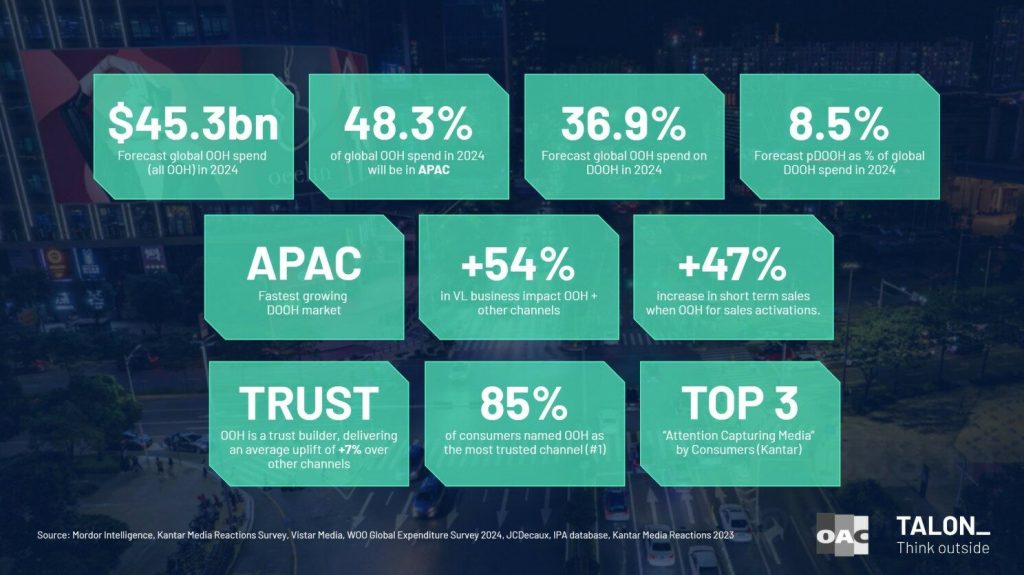
The recent World Out of Home Organization expenditure results show impressive gains and projected gains in share of expenditure at a projected 5.3% for 2024. APAC receives the lion’s share of this investment. Digitization (DOOH) leads this growth, as does an emerging PDOOH (programmatic DOOH) investment. Research proves that consumer TRUST in OOH as a medium is an impressive driver of investment. Using OOH for sales activations also delivers short-term sales results, which defies econometric models where OOH is under-attributed. Overall, the Global OOH industry is performing projections expect this to continue.
Tom Goddard from WOO also presented these findings in-depth the previous day at the conference and can be found here – https://www.worldooh.org/news/2024-global-expenditure-survey
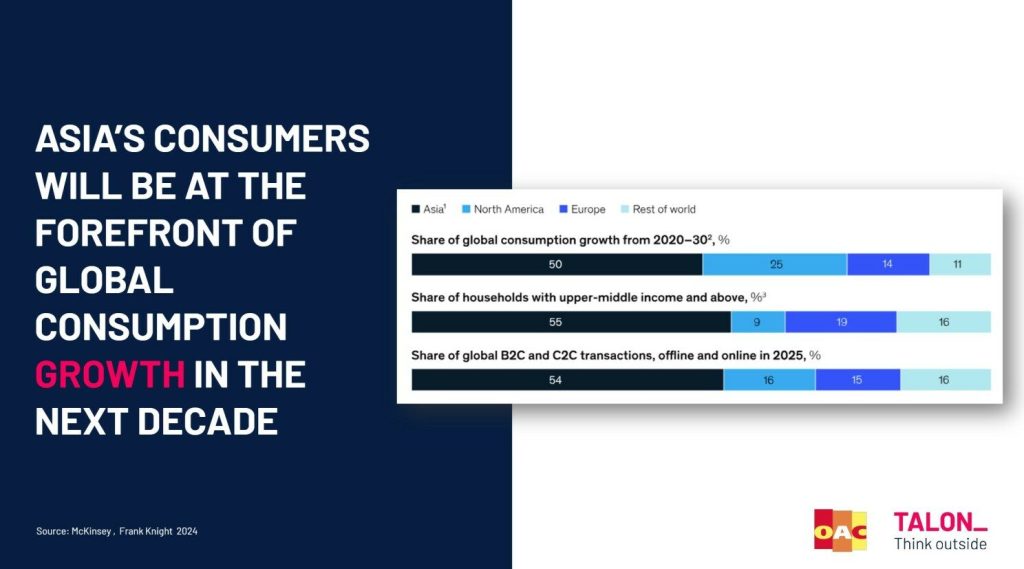
APAC consumers are growing, as is their wealth and consumption. In 2023, Global GDP expanded by 3.1%, and emerging economies and Asia led the recovery, with India as a notable example. By 2030, APAC projections are that 20+ cities will have one Million+ upper-income households, driven by growth in China, Japan, and India. Then, there is consumer consumption in Asia:
- 50% projected share of global consumption growth (2020 – 2030)
- 55% share of global households with upper-middle income and above
- 54% projected share of global B2C and B2B transactions, offline and online (in 2025)
THREE LEVERS OF GROWTH FOR THE OOH INDUSTRY
Statistics show growth and projected buoyancy in the region; it is time to accept change for the OOH industry. Those who do not embrace change will be left behind because those who invest in media are evolving in their attitudes, behaviors, and processes. There is an exhaustive list of potential areas of focus, but these three are what I chose to highlight that can help propel the industry forward – The Sales Model, The Talent, and The Tech.
Digital was not a consideration when original OOH sales model were designed. Single-site selling was the norm, and there was an almost linear engagement with clients. There are so many demands, considerations, expectations, and competition that old sales models are under pressure. From spot buying, DOOH, programmatic, audience selling, creative, data, measurement, triggers, verification, experiential, and anamorphic, along with considering multiple markets, cross borders, varying currencies, cultures, and languages .. it is complex.
Initially, “Brief to Response” time expectations were measured in weeks. Now, demand is rapidly moving to a self-service model for clients and their agencies, with demand for information at their fingertips for near-instant options, pricing, and availability. Change is coming, and those not adapting to this customer-driven demand will be left behind. And yet, there are still sales models/processes that need to adapt to the feverish requirement for fast, accurate information that does not require human intervention from the media owner-side.
Change is coming, and those not adapting to this customer-driven demand will be left behind.
Media owners must transform their sales models, and connecting their information pipes to the media buying ecosystem is essential. This is a lever for growth.
THE TALENT
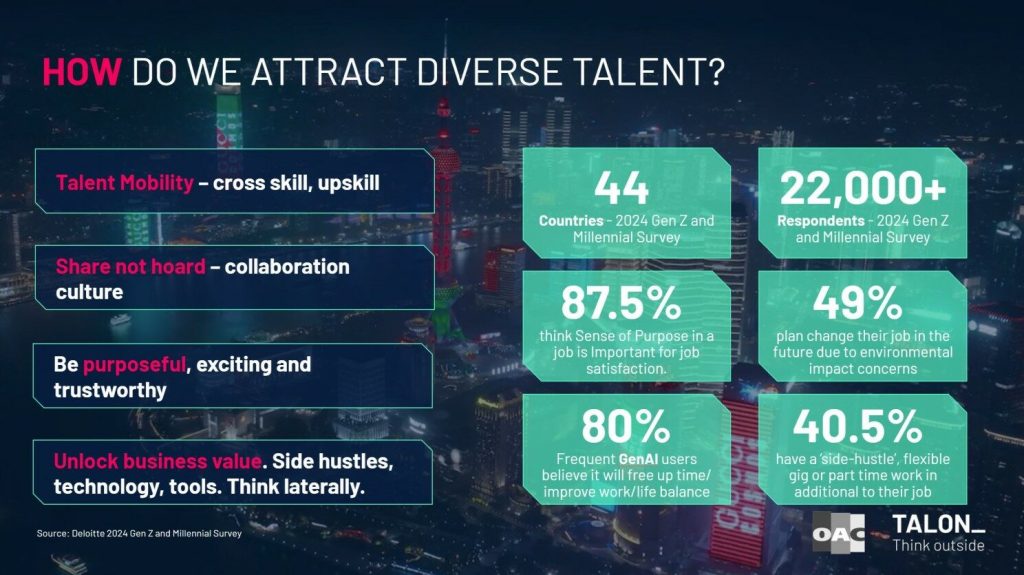
The most effective leaders surround themselves with the right talent, skills, roles, and mindset and then harness it to propel their business forward. We need to infuse our businesses with diverse, talented people who want to be a part of our growth.
Dominating digital investment and tech transformation has created a skills and knowledge gap for OOH, and we must bridge it.
To transform the OOH industry, we must seriously consider the talent needed for growth. Not one generation or gender has all the answers, innovation, or ideas, so diversity of talent is critical to the Talent formula. Creating environments where collaboration and knowledge sharing (“share not hoard”) are the norm is vital.
No one generation or gender has all the answers, innovation, or ideas, so diversity of talent is critical to the Talent formula.
OOH media is competing with other businesses for the best talent. However, the halcyon days of free food and ping pong tables no longer attract the best talent. It is all about talent mobility, learning cultures, purpose, and fostering entrepreneurialism. Read the Deloitte 2024 Gen Z and Millennial Survey for more insight. It is a great read and perspective for anyone wanting to attract the largest emerging workforce generation of this time. What struck me about this report was how fearless the emerging generational workforce is about technology, innovation, and automation. They want to embrace it.
I caveat this with an important point. We should retain the incredible intellectual property and capability of those currently in the OOH industry, as they are invaluable. The goal should be to bolster capability and infuse new knowledge to grow the industry using the successful foundations of those who have built it successfully before.
THE TECH
Tech could be the subject of an entire week of discussion, but in the context of this presentation, I focus on how tech can transform the industry towards the self-service model mentioned in The Sales Model section.
Tech solutions remove duplication , and manual processes improve speed and agility. Tech solutions also allow us to redirect human talent to advocacy, education, and innovation. This will fuel growth for OOH, DOOH, and pDOOH. Especially if Audience Measurement is a priority.
If something is not measured, it has no value. If it has no value, it is not valued. For OOH buying, it is easier to justify removing a site, media owner, and country from a plan if there is no audience measurement.
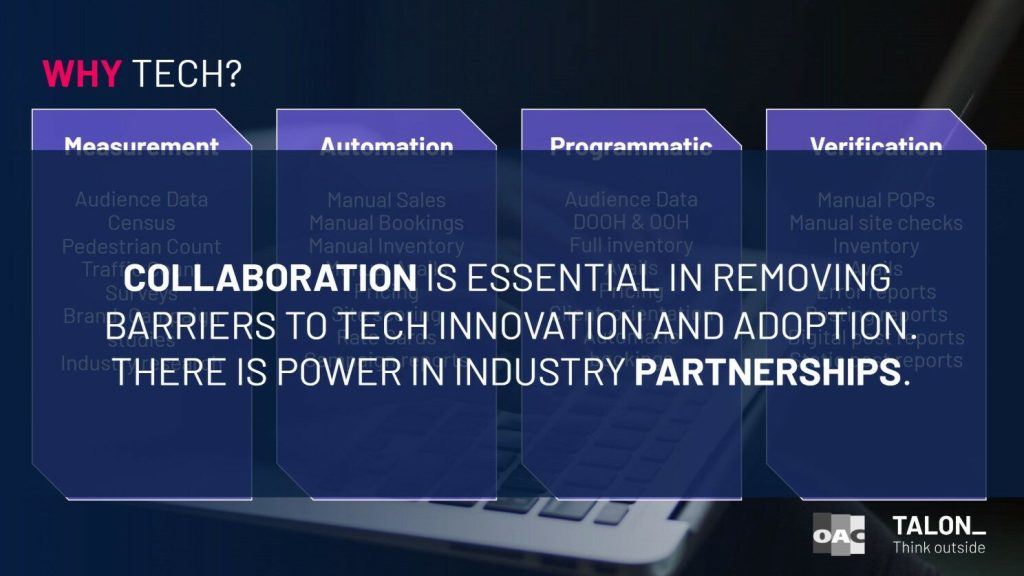
The four key areas where Tech can make a considerable difference are in
- Measurement – tech that can make sense of what we know will be trillions of data lines, including location, audience, traffic, expenditure, behavioral, attitudinal, campaign, and neuro for every country, city, OOH, DOOH, and pDOOH site. Imagine that.
- Automation—There is extraordinary duplication and human intervention in the OOH buying process. Technology can remove duplication in the sales, booking, planning, inventory, reporting, and verification process, which would eradicate wastage and free up skills and resources for other parts of the business.
- Programmatic—The tech in programmatic is advancing, but the tech could power the entire OOH ecosystem, not just DOOH. The tech would remove planning friction, as the data would be fully accessible for planning purposes. However, this requires media owners to connect their data and become visible to global and local planners. Currently, some markets and media owners are resisting this change.
- Verification is an emerging tech that I do not see waning, especially with third-party independent verification partners. These tech bolt-ons allow agencies, brands, and media owners to verify media plan deliverables independently. OOH media has historically done this via POPs (proof of play, proof of posting photos and video) and Digital POP reports (reports from the media owners’ system on plays of digital ads) and provide post-campaign. However, independent verification, especially on large campaigns, assures clients they got what they paid for.
Collaboration is essential in removing barriers to tech innovation and adoption. There is power in industry partnerships.
Barriers to “The Tech” center around long-term, high capital expenditure requirements. However, there doesn’t need to be individual media owners building custom, bespoke technology in insolation; there is power in collaboration and pooling of resources for the betterment of the industry and connecting via partnerships with AdTech suppliers to the industry. There is a textbook case study for this in the Outdoor Media Association in Australia, where media owners initially collaborate and invest in improving their industry via an audience measurement system, MOVE, now an accepted industry currency. This 10+year collaboration has grown the Australian OOH industry significantly. OMA Chair Charles Parry-Okeden further reiterated this in his presentation at #OAC2024.
During the same conference, Raeem International’s innovative work was recognized as we won two prestigious awards in the DOOH International category at the OAA Awards 2024:
Silver Award for Unilever’s LUX campaign ‘Illuminating The Story To Life’. This campaign, ‘Yeh Chand Zameen Per Kaise,’ captivated audiences with stunning visuals and emotive storytelling, demonstrating our agency’s ability to create impactful and memorable advertising experiences.
Bronze Award for Unilever’s Ponds campaign ‘Bina Chip Chip Soft Skin,’ recognized as the first Audible DOOH campaign in Pakistan. This groundbreaking initiative highlighted our forward-thinking approach, pushing the boundaries of traditional advertising.
A Risk and an Opportunity | Over-Digitization
In our rush to digitize the OOH space, there’s a risk that media owners may over-allocate ad spots on digital screens, reducing Share of Time (SOT) for each advertiser. In some regions, DOOH allows just a 1.67% SOT, which makes it both costly and inefficient.
OOH strategies should always incorporate traditional static formats along with digital ones to maximize reach and frequency. The full 100% Share of Voice that static OOH provides remains an invaluable asset for brand-building campaigns.
As the OOH industry evolves, embracing innovation and driving change will be essential to remaining competitive. We must collaborate as an industry to ensure that OOH continues to thrive in a rapidly changing media landscape.
